

Education
Brief Bio
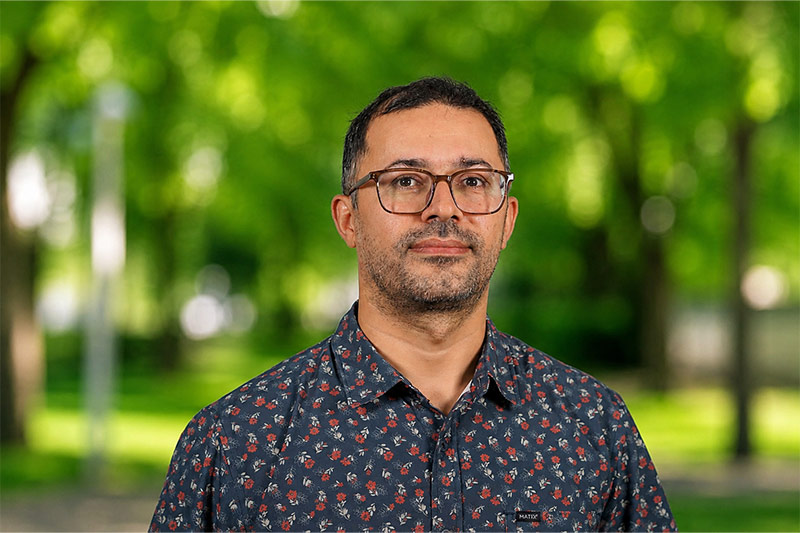
Dr. Hossein Ghorbani-Menghari is a Lecturer in the Department of Mechanical Engineering
at the South Dakota School of Mines & Technology (SDSMT). He earned his Ph.D. in Mechanical
Engineering from Pusan National University, South Korea, where his research focused
on computational mechanics, powder compaction, and advanced manufacturing processes.
Prior to joining SDSMT, he served as a Postdoctoral Researcher at Pusan National University,
conducting research on crystal plasticity finite element modeling, fatigue prediction,
and lightweight materials.
Dr. Ghorbani-Menghari's research interests include finite element analysis, metal
forming, powder metallurgy, additive manufacturing, tribology, and machine learning
applications in manufacturing. He has authored numerous peer-reviewed journal articles
and conference papers, published technical books, and actively contributes to the
engineering community through student mentorship, journal reviewing, and collaborative
research projects with academic and industry partners.
Research Expertise
Dr. Ghorbani-Menghari's research focuses on computational mechanics and advanced manufacturing, integrating physics-based modeling, finite element analysis, and data-driven optimization to understand and improve manufacturing processes. His work spans powder metallurgy, metal forming, additive manufacturing, tribology, and fatigue analysis, with an emphasis on predicting material behavior across multiple length scales. He employs advanced simulation techniques, including crystal plasticity finite element modeling (CP-FEM), discrete element methods (DEM), multiscale modeling, and machine learning approaches to enhance process design, material performance, and manufacturing efficiency. Overall, his research aims to develop intelligent and predictive engineering frameworks that support the design of advanced materials and next-generation manufacturing systems.