

Mines Researchers Play Key Role in World-Leading Dark Matter Results from LZ Experiment at SURF
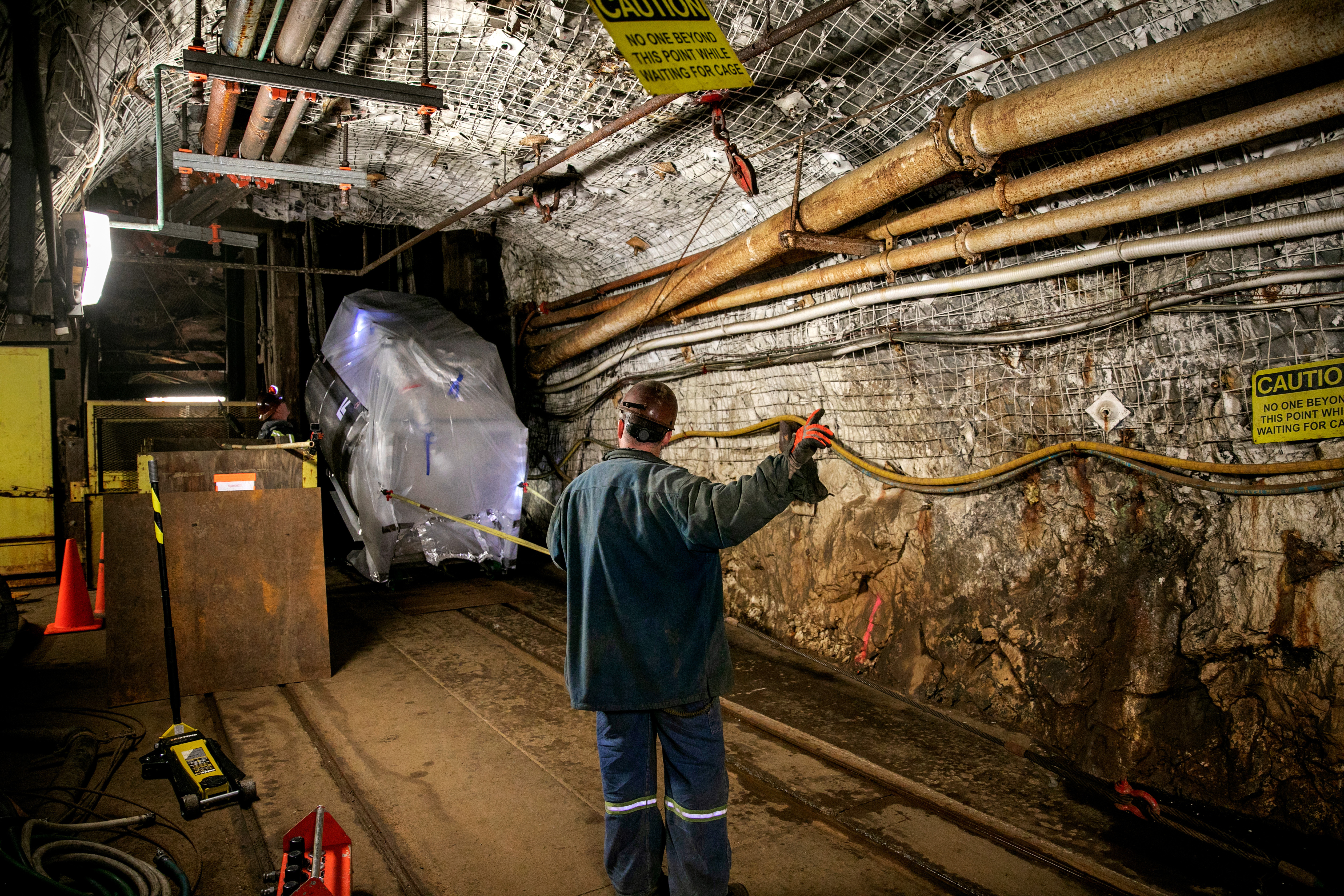
Nearly a mile beneath the surface of western South Dakota, one of the world's most sensitive physics experiments is quietly listening for signals from the unseen universe with researchers from South Dakota Mines helping guide every pulse it records, including the newest record-breaking results.
The LUX-ZEPLIN (LZ) experiment at the Sanford Underground Research Facility has analyzed the largest dataset ever collected by a dark matter detector, delivering the most sensitive search yet for low-mass dark particles and revealing new signals from neutrinos produced in the sun’s core.
LZ, led by the Department of Energy’s Lawrence Berkeley National Laboratory (Berkeley
Lab), hunts for dark matter from a cavern nearly one mile underground at SURF.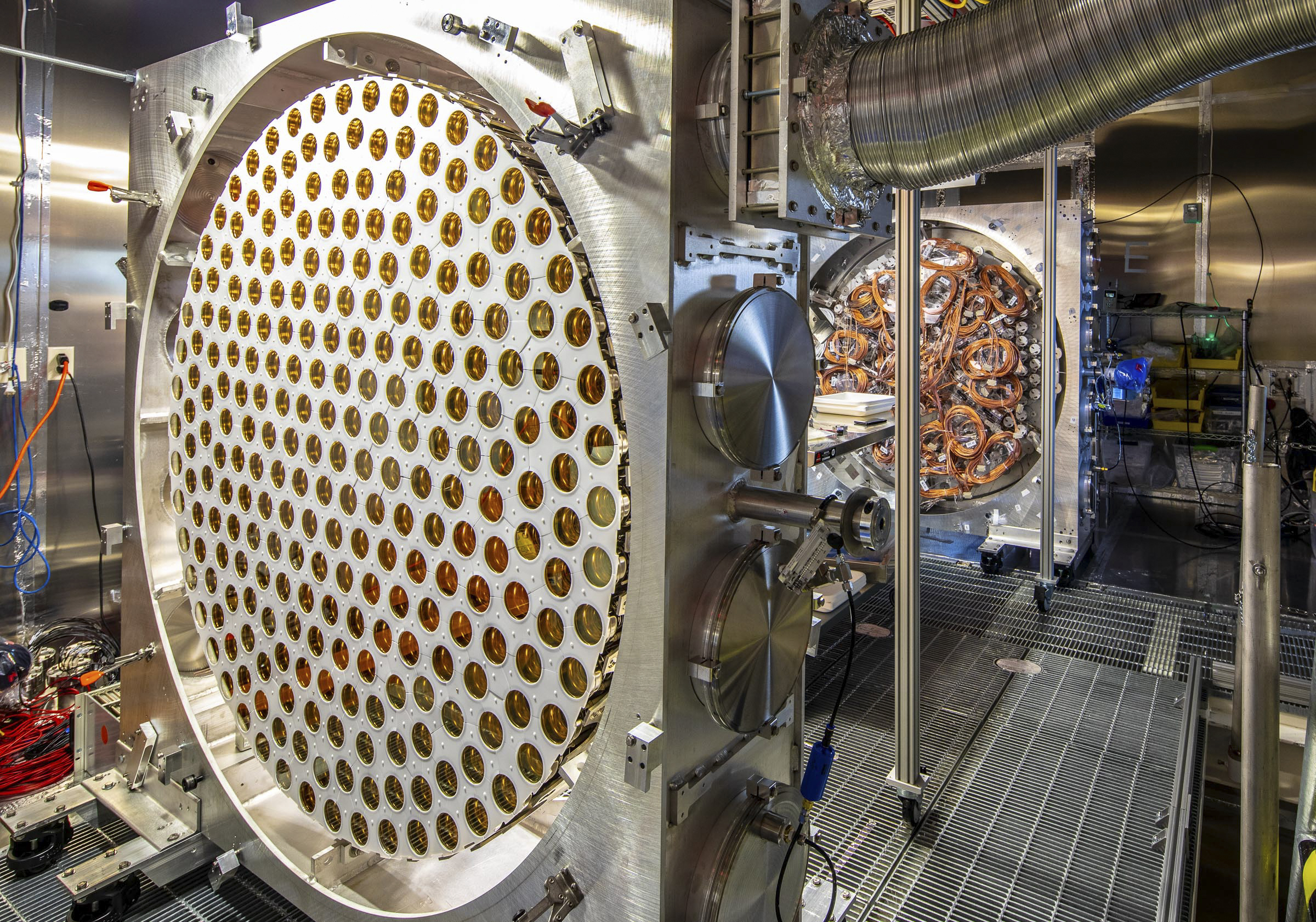
The international collaboration, made up of 250 scientists and engineers from 37 institutions, announced this week world-leading results that significantly narrow the possible properties of weakly interacting massive particles (WIMPs), a leading candidate for dark matter. At the same time, the experiment achieved a major milestone by detecting boron-8 solar neutrinos, providing the detector’s first glimpse at the “neutrino fog” – signals from neutrinos that mimic those thought to be produced by dark matter.
LZ uses 10 metric tonnes, or 10,000 kilograms, of ultra-pure liquid xenon to search for the faint interactions expected from dark matter. The newly released analysis is based on 417 live days of data collected between March 2023 and April 2025, the largest dataset ever used in dark matter research. The results found no sign of WIMPs with a mass between 3 GeV/c2, roughly the mass of three protons, and 9 GeV/c2.
“We have been able to further increase the incredible sensitivity of the LUX-ZEPLIN detector with this new run and extended analysis,” said Rick Gaitskell, a professor at Brown University and the spokesperson for LZ. “While we don’t see any direct evidence of dark matter events at this time, our detector continues to perform well, and we will continue to push its sensitivity to explore new models of dark matter. As with so much of science, it can take many deliberate steps before you reach a discovery, and it’s remarkable to realize how far we’ve come. Our latest detector is over 3 million times more sensitive than the ones I used when I started working in this field.”
Researchers from Mines, one of the 37 collaborative institutions, made key contributions to the experiment’s success.
Juergen Reichenbacher, Ph.D., associate professor in the Mines physics department, started working with the LZ experiment in 2012. Reichenbacher and his team focused on calibration source characterization and deployment, correcting signal losses and implementing remote control capabilities to operate the LZ detector deep underground.
"Without regularly calibrating the detector, we would basically fly blindly and could not possibly interpret the data that LZ recorded up to now in a meaningful way,” Reichenbacher said.
Reichenbacher's research scientist Gleb Sinev, Ph.D., leads the team responsible for LZ’s remote system control of the detector. "One could reasonably argue that comprehensive remote-control capabilities to operate and monitor the LZ detector underground 24/7 have been mission-critical to record enough quality data in time to be able to come out now with our new world-leading result,” he said.
Richard Schnee, Ph.D., head of the physics department at Mines, is among the leading researchers in the world on radon reduction for ultra-sensitive physics experiments like LZ. Schnee led the design and build team for a critical system that removed radon from the LZ cavern.
“People in the general public might have heard about the health hazards of radon levels in their basements, but for dark matter searchers underground, this background could ruin the results if not mitigated,” Schnee said.
Sagar Sharma Poudel, a postdoctoral researcher with Schnee, contributed to detector calibration, data analysis and low-energy pulse analysis.
“I find it exciting that the LZ experiment is publishing world-leading limits in WIMPs dark matter detection,” Poudel said. “I am happy to have contributed to some aspects of the experiment, both in operations and on the analysis side.”
Beyond dark matter, LZ’s extreme sensitivity allowed scientists to observe boron-8 solar neutrinos, providing a window into how neutrinos interact and the nuclear reactions produced by fusion in the sun’s core through a rare process known as coherent elastic neutrino-nucleus scattering (CEvNS). The observation reached the 4.5-sigma confidence level – the strongest evidence to date for this interaction in xenon and an important validation of detector performance.
While neutrinos present a background challenge for future low-mass dark matter searches, their detection also opens new opportunities for studying neutrino physics and processes occurring in the sun’s core.
“Seeing these neutrino interactions is a pivotal milestone,” said Dan Kodroff, a Chamberlain Fellow at Berkley Lab and co-lead of the analysis. “It simultaneously showcases LZ’s ability to detect signals of cosmic origin while also giving us new avenues for probing solar and neutrino physics to test the Standard Model (of Particle Physics).”
LZ will continue collecting data through at least 2028, more than doubling its exposure and further expanding its reach into uncharted physics territory. The collaboration is also helping design a next-generation detector that will build on LZ’s success to probe dark matter, neutrinos and other rare phenomena with even greater sensitivity.
LZ is supported by the U.S. Department of Energy, Office of Science, Office of High Energy Physics and the National Energy Research Scientific Computing Center, a DOE Office of Science user facility. LZ is also supported by the Science & Technology Facilities Council of the United Kingdom; the Portuguese Foundation for Science and Technology; the Swiss National Science Foundation, and the Institute for Basic Science, Korea. Over 38 institutions of higher education and advanced research provided support to LZ. The LZ collaboration acknowledges the assistance of the Sanford Underground Research Facility.
This release was first published by Lawrence Berkeley National Laboratory and the original can be found on their website here.