

South Dakota Mines Professor Recognized as a KEEN Rising Star
Engineering is more than solving complex problems; it is combining technical skills with empathy and compassion to make decisions that improve communities.
That focus on human-centered engineering has been Cristian Vargas-Ordóñez’s teaching model since joining the South Dakota Mines faculty in 2024. That guiding principle has also earned Vargas-Ordóñez, Ph.D., assistant professor in the Leslie A. Rose Department of Mechanical Engineering, the honor of being named a 2026 KEEN Rising Star. The Kern Entrepreneurial Engineering Network (KEEN) is a partnership of more than 70 colleges and universities across the United States. Each year, KEEN leaders select faculty members on their campus who best exemplify the spirit of an entrepreneurial mindset – attitudes, habits and behaviors that shape a unique approach to problem-solving, innovation and value creation - in engineering education. Vargas-Ordóñez was one of only 19 KEEN Rising Stars selected nationally this year.
“It is fantastic that Dr. Vargas-Ordóñez's has been recognized with a 2026 KEEN Rising Star Award,” said Pierre Larochelle, Ph.D., department head. “His cutting-edge engineering education research efforts to infuse both an entrepreneurial mindset and human-centered engineering into his hands-on, project-based courses are some of the ways that the Leslie A. Rose Department of Mechanical Engineering stays at the forefront of mechanical engineering education, providing our students and the state of South Dakota a world-class mechanical engineering education experience.”
The award reflects Vargas-Ordóñez’s commitment to preparing engineers who are not only technically skilled but also curious, empathetic and driven to create meaningful value through their work, an educational philosophy rooted in his doctoral research at Purdue University.
“Engineering education has traditionally emphasized solving well-defined technical problems,” he said. “The entrepreneurial mindset encourages students to begin one step earlier by asking whether they are solving the right problem, for whom and what value their work creates.”
By encouraging students to think beyond technical solutions, Vargas-Ordóñez believes they become more thoughtful engineers who approach challenges with curiosity, empathy and a sense of responsibility. “It can prepare graduates to develop innovative technologies and understand the broader contexts in which those technologies will be used,” he said. “Whether students eventually work in industry, research, government or start their own companies, these habits of the mind can make them more adaptable and more effective engineers.”
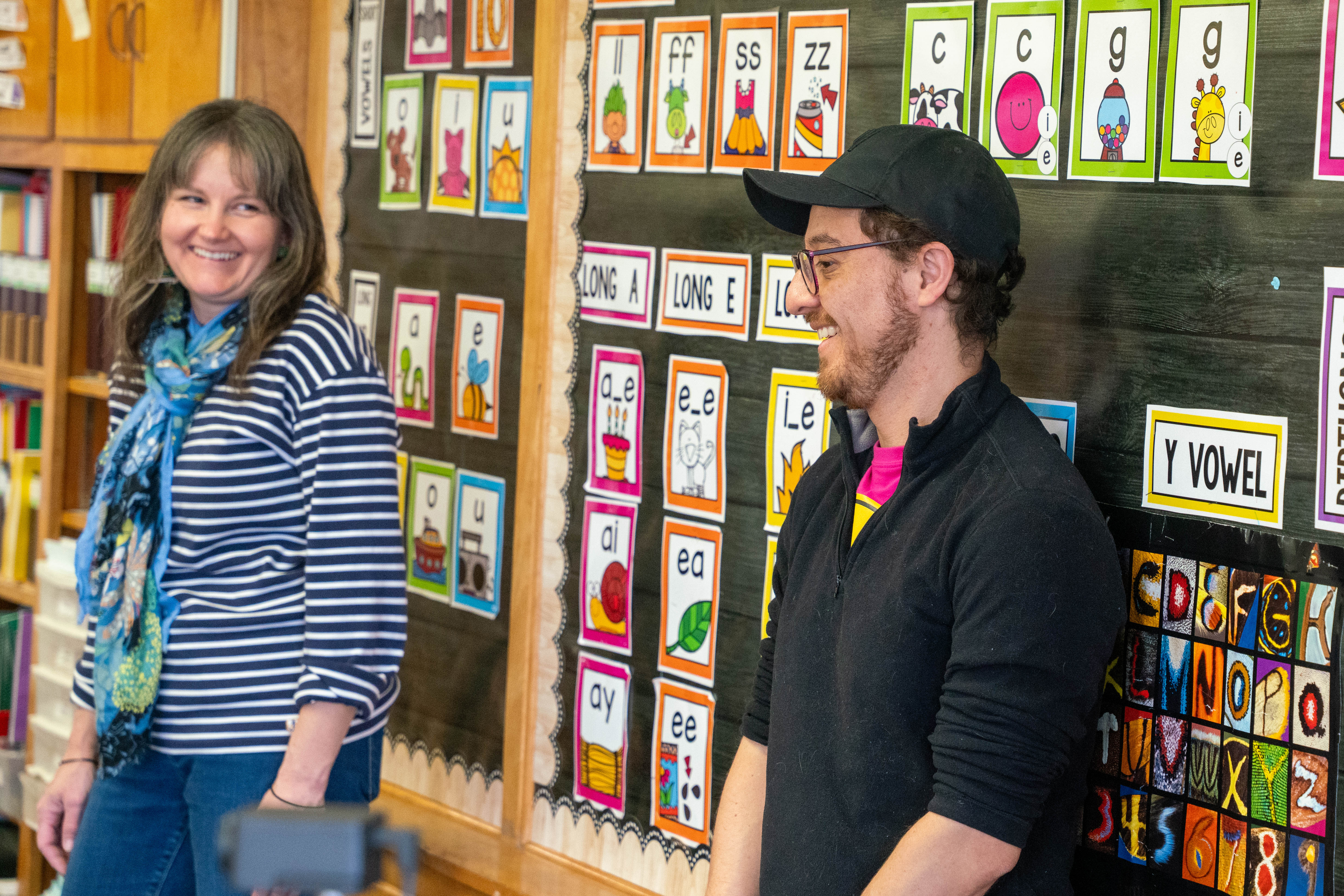
Just this spring, Vargas-Ordóñez and his research team worked with first graders at
Rapid City’s Wilson Elementary School to create hands-on toys that introduced foundational engineering
concepts through play. The project, “Designing Engineering Toys Through School-University
Co-Design: A Pilot for Inclusive Learning,” aims to make engineering education more
accessible, engaging and culturally responsive for young learners while strengthening
connections between local schools and higher education.
Elementary School to create hands-on toys that introduced foundational engineering
concepts through play. The project, “Designing Engineering Toys Through School-University
Co-Design: A Pilot for Inclusive Learning,” aims to make engineering education more
accessible, engaging and culturally responsive for young learners while strengthening
connections between local schools and higher education.
Rather than treating the entrepreneurial mindset as a stand-alone topic, Vargas-Ordóñez integrates it into engineering design experiences where students identify stakeholders, explore opportunities, consider societal needs and create value through their technical work. “My teaching already emphasizes human-centered engineering, so I see the entrepreneurial mindset as a natural alignment,” Vargas-Ordóñez said. “Students are encouraged to design technically sound solutions and ask who benefits, whose perspectives and value are missing and how engineering decisions affect people and communities.”
Moving forward, Vargas-Ordóñez plans to incorporate the entrepreneurial mindset more intentionally into his curriculum, including aligning the cornerstone project for first-year mechanical engineering students with entrepreneurial mindset concepts such as opportunity recognition, value creation and stakeholder-centered design.
“As engineering challenges become increasingly complex, I believe our responsibility is to prepare graduates who are compassionate, curious, collaborative and thoughtful professionals,” he said.
Vargas-Ordóñez is honored to be a KEEN Rising Star at such an early stage in his academic career and said it is meaningful to know his colleagues see value in his efforts to understand how the entrepreneurial mindset relates to engineering education. The award is also a reminder that educational innovation happens through collaboration. “My involvement with KEEN has connected me with a community of engineering educators who are willing to experiment, share ideas and continuously improve how we prepare future engineers,” he said. “I see this recognition as a motivation to continue learning from that community while contributing my own perspective and expertise grounded in engineering education research.”
Vargas-Ordóñez will be officially recognized in January during the 2027 KEEN National Conference in Oklahoma City