

Undergraduate Students Spend Summer Diving into Research at South Dakota Mines
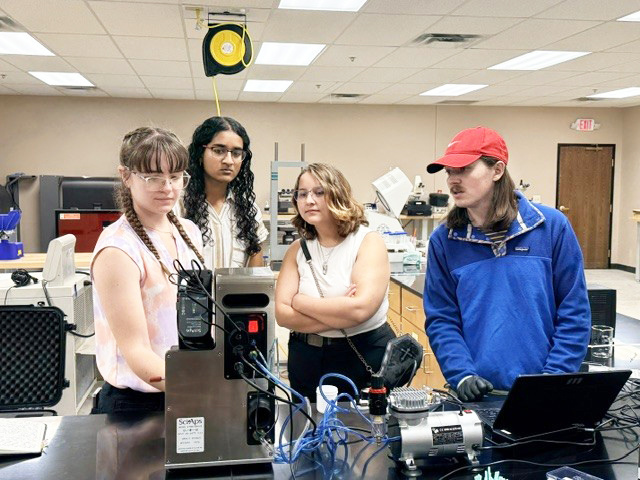
Jocelyn Suranyi, Neha Jupalli, Krista Burkman and Louis Rancour, all undergraduates from across the country, spent the summer at South Dakota Mines in science and engineering labs across campus, working on research projects focusing on everything from counterfeit IDs and lithium to metal coatings and space debris.
The four students were among more than 30 in the summer Research Experience for Undergraduates (REU), intensive paid research programs funded by the U.S. National Science Foundation and university departments. In addition to the REU, several other students participated in research opportunities, including the National Institutes of Health and the Accelerated Career Exploration.
One of those students, Suranyi, a chemistry major from Kalamazoo College in Michigan, worked with Mines professors Jon Kellar, Ph.D., in materials and metallurgical engineering, and Prasoon Diwakar, Ph.D., in mechanical engineering as part of the Collaboration to Combat Crime REU program. Her project focused on using multimodal spectroscopy to authenticate driver's licenses.
"We were taking driver's licenses and collecting information using different wavelengths of light and elemental analysis to identify the differences between counterfeit and authentic IDs," Suranyi said. "The goal is to create a machine learning model that can use this information to automatically determine whether an ID is real or counterfeit."
The team's research identified a method that distinguished fake IDs from authentic ones with a high degree of accuracy.
While the project was a departure from the synthetic chemistry research Suranyi had been doing at Kalamazoo College, she said the experience broadened her skills and introduced her to new techniques and tools that will benefit her future work.
"I think programs like this are really important," she said. "My time this summer was incredibly valuable. Learning from graduate students, hearing about their experiences, and getting hands-on experience with different lab equipment was really exciting."
For Jupalli, a data science major at the University of Florida, this summer was her first experience with research as part of Lithium Sustainability, Mining, Recycling, and Technology (Li-SMART) REU program. A self-taught student of machine learning, Jupalli expanded her skills using AI for lithium ore classification using handheld LIBS, a portable device that uses laser-induced breakdown spectroscopy for rapid, on-site elemental analysis and alloy identification.
“I really enjoyed the project because I learned more about machine learning and more about collecting data and applying my skills,” she said. “I also got to work with professionals like Dr. Diwakar and graduate students in the lab. It was a great experience.”
Diwakar added that Jupalli was working with “messy” samples, minerals, and ores taken directly from the mines from all over the world. “They were not polished samples, but actual real-world samples,” he said. “So she is taking the textbook knowledge and applying them to the real world.”
Jupalli spent the summer answering a variety of questions, including identifying the type of ore, the concentration and where it came from.
Jupalli and Suranyi’s summer REUs were both funded by NSF grants. Burkman, a Mines mechanical engineering major, conducted research funded by a gift from alumnus Larry Pearson and his wife Linda to the Leslie A. Rose Department of Mechanical Engineering. Burkman is expanding the space debris research started by Jaden Dougal, who graduated with her master’s degree this past May. Burkman’s research explores additional complexities, including incorporating spin into models that use laser pulses to alter the trajectory of space debris and its safe removal. “Sometimes space debris is spinning, which tends to create more damage and more difficulties in exploring space,” she said.
Burkman is also studying the different materials that make up space debris and how the lasers may affect them differently.
Rancour, a sophomore metallurgical and ceramic engineering student at Mines, spent the summer participating in the Back to the Future REU working with Michael West, Ph.D., head of the university's Department of Materials and Metallurgical Engineering. “I thought this would be a great way to gain more experience in the lab and contribute to research that would propel society ‘back to the future,’” he said.
He researched nickel electrodeposition, an electrochemical process that coats metal objects with a thin layer of nickel, examining how additives, temperature and glycine concentration affect the process. While there is much more work to be completed, Rancour said he collected a lot of data that will help move the research forward.
“Programs like these give undergraduate students a chance to apply the basic principles that they have learned in the classroom, and give them first-hand experience in the complexity of problems that need to be solved, and give them the necessary guidance so they can contribute to solving those problems,” he said,
Diwakar, who started his undergraduate STEM experience participating in an REU, said these programs give students the opportunity to explore different facets of giving them an idea of what they may or may not want to do.
“This is a good time to explore before they jump on a career path,” he said. “And even if they don’t like the research, they will learn tools that will be beneficial to them.”
In addition to the firsthand research experience, the students also had the opportunity to learn about graduate student life from mentors, and present at their research at various symposiums.