

South Dakota Mines Researchers Contribute to Nobel Prize-Winning IceCube Experiment
The 2026 Nobel Prize in Physics recognizes a scientific breakthrough that South Dakota Mines researchers are helping advance using elusive subatomic particles called neutrinos to explore the universe’s most energetic and mysterious environments.
Francis Halzen, Ph.D., a physics professor at the University of Wisconsin-Madison, recently received the 2026 Nobel Prize in Physics for his contributions to the IceCube Neutrino Observatory and the discovery of high-energy neutrinos of astrophysical origin.
Halzen understood that the ice at the South Pole could be used to track neutrinos.
Halzen first presented his revolutionary vision for capturing neutrinos at the South Pole in the 1980s. When a neutrino collides with an atomic nucleus, it produces a flash of light that can be tracked by sensors in the glacial ice. The glacial ice at the South Pole offers several advantages: it is free from various types of interference and possesses a stable geological structure; more importantly, it is home to the U.S. Amundsen–Scott South Pole Station which operates year-round. After years of demonstrating with the Antarctic Muon and Neutrino Detector Array (AMANDA), Halzen and his idea gained support from more researchers and funding agencies to build the IceCube Observatory.
According to a press release from The Royal Swedish Academy of Science, “his vision and scientific leadership have been fundamental for the IceCube Neutrino Observatory – a cubic kilometer of ice that is equipped with light sensors. Using IceCube, researchers can capture neutrinos from extremely energy-rich processes in the distant universe.”
Mines is one of 58 institutions across 14 countries that comprise the IceCube Collaboration – an international team driving research and operations at the IceCube Neutrino Observatory. The observatory has opened a new window into the universe, allowing scientists to investigate phenomena that cannot be fully understood through traditional astronomical observations alone.
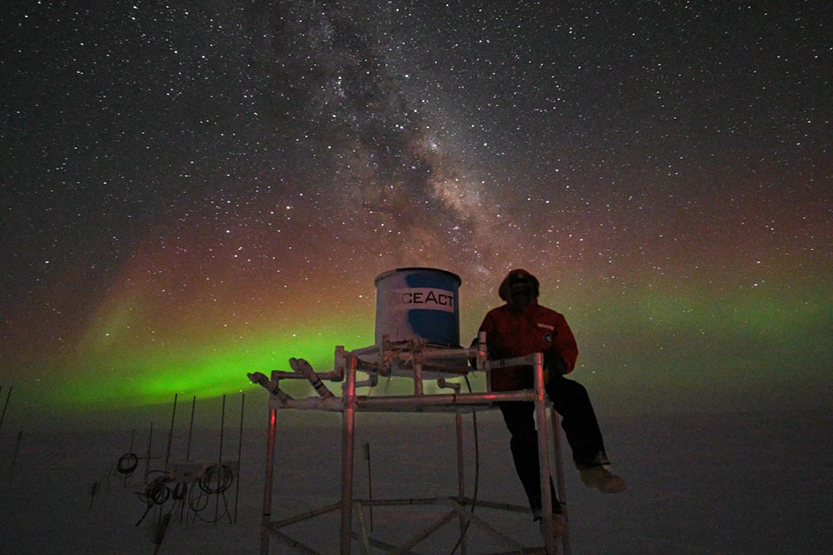
At Mines, researchers have traveled to the South Pole to advance cosmic ray studies. The IceCube Neutrino Observatory collects data from its in-ice array and surface array, IceTop. In 2024, Larissa Paul, a research scientist in the university's physics department, installed four telescopes at the observatory, adding another view of cosmic ray events flashing in the Earth's atmosphere above the IceCube Observatory.
Paul’s trip to the South Pole was funded by the National Science Foundation (NSF) grant Windows on the Universe Multi-Messenger Astrophysics: Cosmic-Ray Physics with IceCube and an extension of a $6.6 million NSF grant the university received in 2020. The four-year project titled “RII Track-2 FEC: The IceCube EPSCoR Initiative (IEI) – IceCube and the Data Revolution” brought together scientists from South Dakota Mines, the University of Alabama, the University of Alaska–Anchorage, the University of Delaware, the University of Kansas, the University of Nebraska-Lincoln, and Southern University and A&M College.
“Thanks to Francis's outstanding leadership, several of us have journeyed all the way from AMANDA (predecessor to IceCube) to the present day,” said Xinhua Bai, Ph.D., Mines professor of physics and one of the founding members of the IceCube Collaboration. Bai led research to enhance big data processing and prepare for the IceCube Gen-2, a highly anticipated project that would open the neutrino window on the universe to the highest possible energies.
“This EPSCoR FEC award allowed many more to contribute from EPSCoR jurisdictions, including South Dakota, Alabama, Alaska, Delaware, Kansas, Louisiana, and Nebraska,” Bai said. “In recent years, IceCube EPSCoR Initiative faculty have also played a variety of important roles in IceCube, RNO-G (relevant to IceCube-Gen2-Radio), IceCube Upgrade and the preparation for IceCube-Gen2.”
One of those is Matthias Plum, Ph.D., a Mines assistant professor of Physics, who received an NSF CAREER Grant last year to support his research at the IceCube Neutrino Observatory.
“Francis Halzen’s prize recognizes IceCube's first discoveries, but the science is just getting started,” Plum said. “With the IceCube, IceTop, and IceAct detectors, we are improving our understanding of high-energy astroparticle physics; the IceCube group at Mines is helping turn those first glimpses into a clear picture of where the universe’s most energetic particles come from.”
“This is also a moment to pay our sincere tribute to other pioneers who have dedicated their lifetime to the field of astroparticle physics, among whom Professor Thomas K. Gaisser is a preeminent figure,” said Bai. “Tom’s writings and formulas have not only envisioned where we are standing now but also educated generations of researchers in this field, myself included.”
For Mines students, the collaboration offers an opportunity to contribute to an international scientific endeavor while developing practical research skills. Students can gain experience with detector technology, complex scientific data and computational methods used to investigate fundamental questions about the universe.
“What makes me proudest is that our students are doing real research on a Nobel Prize-winning experiment,” Plum said. “Their work at Mines, from building detectors to analyzing cosmic-ray data, contributes directly to how IceCube sees the universe.”
Plum added that he hopes to one day send students to Antarctica to observe firsthand research at the IceCube Neutrino Observatory.
Halzen’s Nobel Prize highlights the impact of a vision that transformed Antarctic ice into a scientific instrument. For researchers at Mines, it also underscores the continuing opportunities to advance the field, improve particle detection and involve the next generation of scientists in exploring some of the universe’s most mysterious questions.