

4,100-Feet Underground Classroom: South Dakota Mines Students Turn Deep-Underground Observations into Testable Science
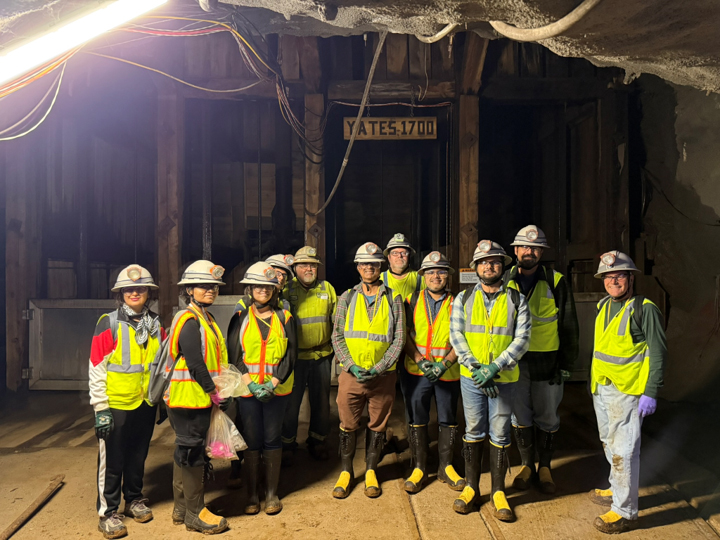
At 4,100 feet beneath the surface, the classroom looks much different than a traditional classroom.
The environment is cool, dark and confined.
Surrounded by solid rock, headlamps illuminate red and blue-silver surface films,
mineral-coated walls, pools of mine water and aging wood – striking interfaces where
biology, chemistry and geology meet and reveal questions that South Dakota Mines graduate
students are ready to answer.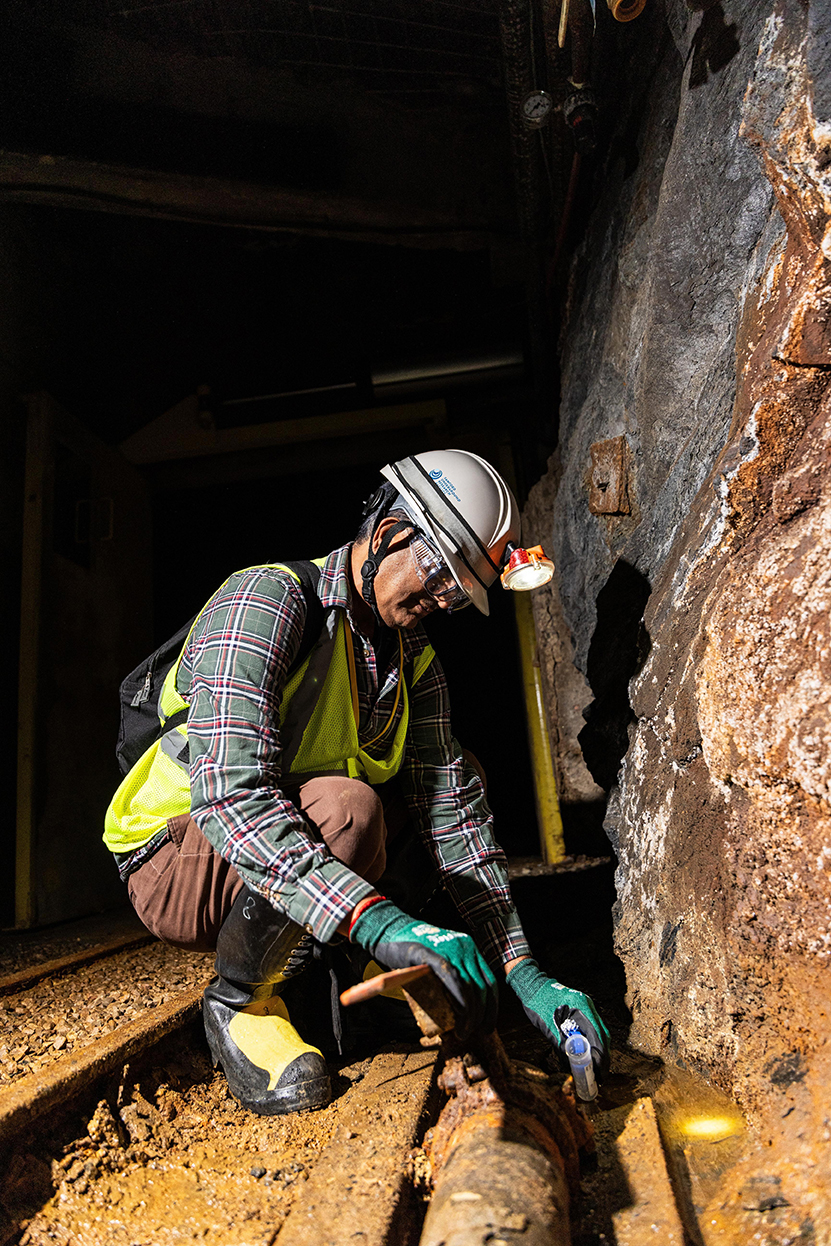
Recently, a group of Mines students, together with other graduate students, research scientists, and visiting researcher Scott Tighe, Ph.D., from the University of Vermont, explored the 4,100-level at the Sanford Underground Research Facility (SURF) as part of the National Science Foundation-funded National Research Traineeship program, combining data science, artificial intelligence and bioengineering for data-driven materials discovery (DDMD) and bio-material interactions.
The trip underground connected graduate education with the practical challenges of discovery, choosing the right sampling sites, strategically collecting samples, documenting environmental conditions and developing hypotheses that can be tested through laboratory research.
“We did not simply take students underground; we placed them at the frontier of questions that no textbook can answer for them,” said Rajesh K. Sani, Ph.D., distinguished professor and director of the Multiomics And Synthetic Biology Center laboratory in the Karen M. Swindler Department of Chemical and Biological Engineering and Department of Chemistry, Biology, and Health Sciences, “At 4,100 feet below the surface, colored biofilms on water or a deposit on rock become an invitation to connect microbiology, geology, materials science, and data. That is the power of experiential learning: students move from learning what is known to asking what remains unknown - and gain the confidence and skills to investigate it.”
The team visited both the 4,100- and 1,700-foot levels, collecting 19 samples from nine locations, including sediments, biofilm-like mats, deposits on rock walls and materials from decaying wood. The team also documented water and crystalline materials.
The team included Dipayan Samanta, Ph.D., and Ram Singh, Ph.D., Mines research scientists, and students Shreya Sinha, Somayeh Falahati Khanaman, Anthony Theodorou, Jasmeet Kaur, Anjali Thapliyal and Lata Pawar, a Fulbright Scholar from India studying at Mines for the year. Sani and Tighe helped guide site assessment and sample selection.
For participants, the underground environment offered an opportunity to observe how water, minerals and biological materials can occur together in ways that prompt new scientific questions.
“The expedition offered a new perspective on mine water and its relationship to underground biological and geological processes,” said Theodorou, a Mines doctoral student in civil and environmental engineering.
The underground experience is one of several student experiences happening under the NRT program, led by Ramana Gadhamshetty, Ph.D., Mines professor of civil and environmental engineering, and in collaboration with the University of South Dakota, Black Hills State University and Oglala Lakota College. The goal is to prepare graduate students to address real-world challenges involving biofilms using artificial intelligence. These communities of microorganisms can benefit water quality, agriculture and biomanufacturing, but can also cause infections, infrastructure corrosion and costly industrial problems. Through hands-on research at sites like SURF, students will explore solutions related to water safety, infrastructure, clean energy and sustainable agriculture.
“The problems that matter most, from clean water to resilient infrastructure, do not arrive sorted by discipline,” said Gadhamshetty. “Through close mentorship across AI, biology and two-dimensional materials science, our students learn to stop asking which field a problem belongs to and start asking what it will take to solve it. The lasting return on this investment is a generation of convergence research leaders who see connections others miss and bring others together to act.”