

South Dakota Mines Receives $3.1 Million DOE/ARPA-E Grant to Accelerate Critical Minerals Exploration
South Dakota Mines has been awarded a $3.1 million grant from the U.S. Department of Energy’s Advanced Research Projects Agency-Energy (ARPA-E) to lead a new research effort aimed at developing advanced technologies that could locate and map rare earth elements (REE) and critical minerals with greater speed and at a reduced cost.
The grant is part of $72 million in ARPA-E funding for early-stage research and development projects to boost domestic magnet manufacturing and help secure America’s supply chains for critical minerals essential to energy security, economic competitiveness and the industrial base. The Mines project, RAPID-REE, is one of 13 projects selected under the ARPA-E’s ROCKS program, joining leading research universities, national laboratories and technology companies in advancing critical minerals innovation.
The RAPID-REE project will develop next-generation exploration and sensing technologies that integrate advanced surface and subsurface sensing with AI- and machine-learning-assisted inversion techniques to more directly detect, map and characterize underground mineral deposits.
“South Dakota has a long history as a mining state, providing essential minerals and resources to the nation, including documented rare earth elements (REE) occurrences,” said Zhi Ye, Ph.D., assistant professor of geology and geological engineering at Mines and the principal investigator for the ARPA-E project. “Advancing critical minerals and REE research and development is an important area of strategic focus for South Dakota Mines, and this initiative will be instrumental in improving critical minerals assessment and enabling responsible development.
The project aims to create accurate 3D maps of ore deposits and reduce uncertainties to improve access to critical minerals. Currently, exploration of critical minerals and rare earth elements can take many years and, in some cases, more than a decade. ARPA-E’s ROCKS program aims to dramatically reduce that timeline.
“We will develop and integrate novel surface sensing technologies combined with advanced subsurface and downhole sensing technologies to more quickly and accurately map ore bodies and determine their grade, size and depth,” Ye said.
Research will include both laboratory and field work, along with techno-economic analysis to support prototype development, testing and eventual commercialization.
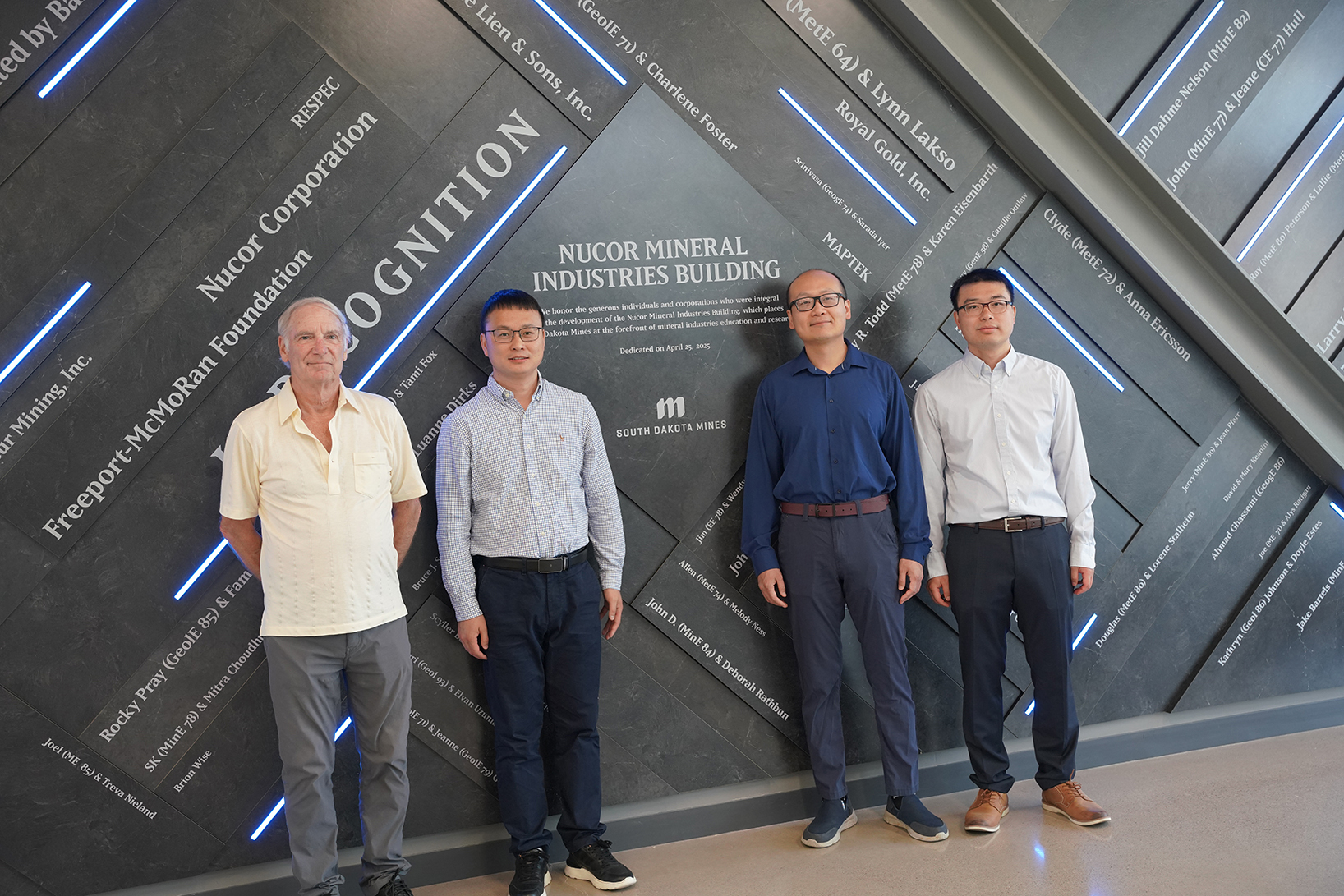
Mines is the lead institution and will oversee the project, as well as design, develop and test both the surface and subsurface sensing prototypes. The university’s multidisciplinary research team also includes Kai Ren, Ph.D., assistant professor of electrical engineering, Mingyuan Chen, Ph.D., assistant professor of nanoscience and biomedical engineering, and William Roggenthen, Ph.D., professor emeritus of geology and geological engineering.
Other key project partners include the University of Oklahoma and New Mexico Tech. The University of Oklahoma team, led by Ahmad Ghassemi, Ph.D., professor of petroleum engineering, will support laboratory testing and numerical simulations to evaluate prototype performance. New Mexico Tech, led by Alex Gysi, Ph.D., associate professor in the Department of Earth and Environmental Science, will provide expertise in REE mineralogy and economic geology and assist with 3D geological modeling for mapping and interpretation.
“South Dakota Mines has a long-standing mission in energy and mineral resources,” said Ghassemi, who earned his master’s degree in geological engineering from Mines in 1986. “I am glad to reconnect with Mines through this exciting project and help strengthen its mission in critical minerals R&D.”
Dakota Gold Corp. will serve as the project’s key industry partner, providing REE samples, industry expertise and access to its Richmond Hill site for prototype testing and validation.
“The Richmond Hill site hosts high-concentration, underexplored REE deposits, making it an excellent site for the project’s field-testing efforts,” said Jack Henris, president and chief operating officer of Dakota Gold and a Mines geological engineering alumnus.
Dakota Gold’s project team will be led by Mark Rantapaa, vice president of operations, and Bill Gehlen, senior manager of geology. Together, they bring more than 50 years of combined mining industry experience to support successful field-scale validation and help establish a practical pathway for future large-scale deployment.