

Mines Professor’s NSF and NERC Award Could Unlock Carbon Isotope Mystery Deep Within Earth’s Heterogeneous Mantle
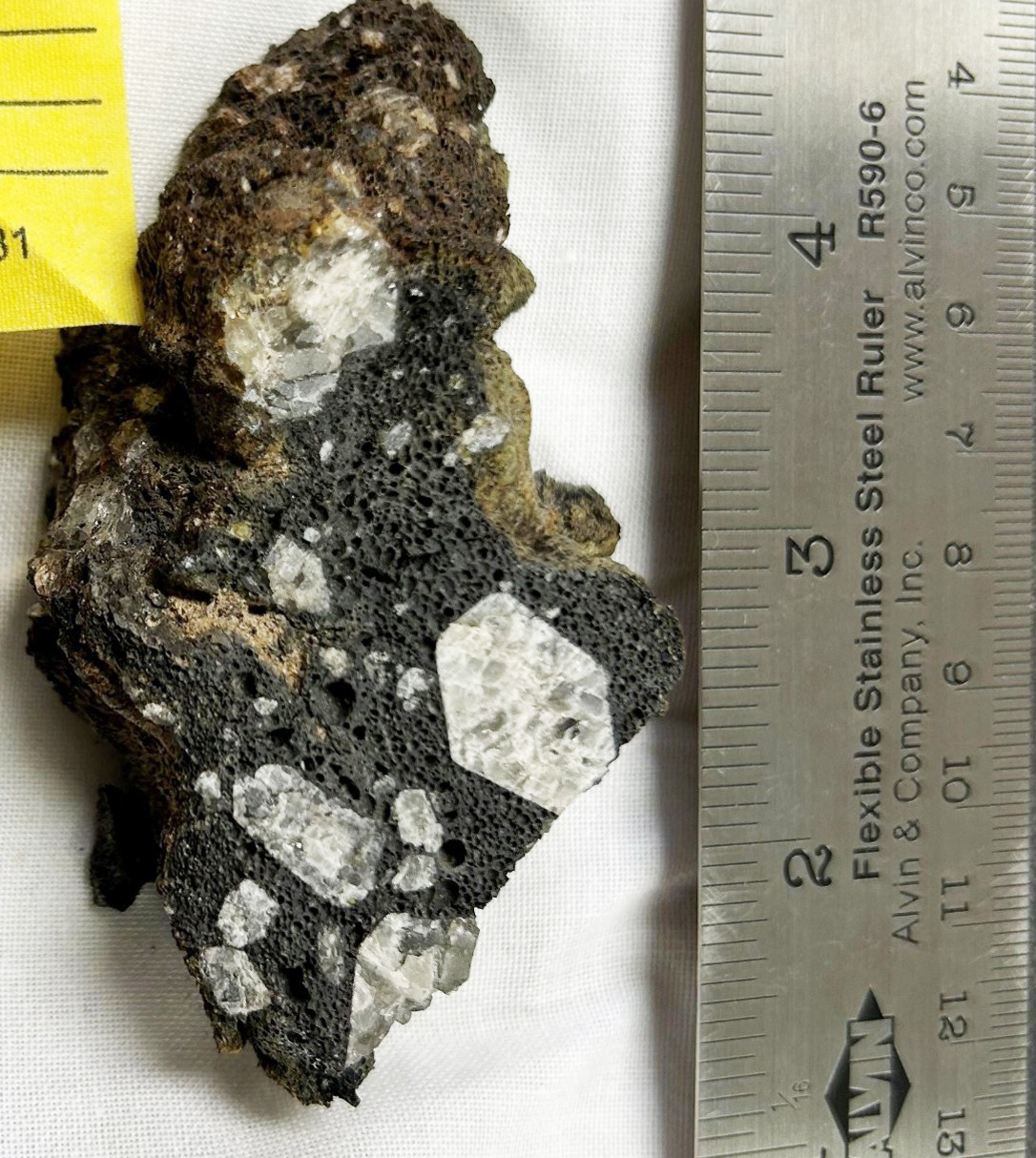
A new international research project led by South Dakota Mines researcher Gokce Ustunisik, Ph.D., associate professor of geology and geological engineering, and collaborators at the University of Cambridge, aims to answer one of Earth science's most fundamental questions: how carbon is stored and released from the planet’s different mantle reservoirs?
Carbon is essential to life, but most of Earth’s carbon is not at the surface or in the atmosphere; it is locked far below in the planet’s mantle, a vast, slowly moving body of rock beneath the crust. Understanding how carbon moves through the deep Earth system could reshape how scientists better understand the impact of volcanic activity and develop better models for the evolution of ocean chemistry and climate.
For evidence of how carbon is stored and mobilized, researchers are turning to tiny ancient magma trapped inside crystals formed deep beneath the ocean floor, called melt inclusions.
The new project led by Ustunisik is jointly funded by the U.S. National Science Foundation (NSF) and the United Kingdom’s Natural Environment Research Council (NERC), and advances the research she completed during her sabbatical last spring as a Derek
Brewer Visiting Fellow at the University of Cambridge.
United Kingdom’s Natural Environment Research Council (NERC), and advances the research she completed during her sabbatical last spring as a Derek
Brewer Visiting Fellow at the University of Cambridge.
The nearly $1 million grant aims to understand the carbon budget in the Earth’s mantle by studying the melt inclusions in crystals from basaltic magmas deep within the Earth. The systems being studied include lavas from the mid-ocean ridge (MOR) system as well as Iceland.
“Mines is leading the effort with $540,000 from NSF Marine Geology and Geochemistry Division of Ocean Sciences (NSF MGG/OCE) supporting Ph.D. and undergraduate researchers while the remaining $400,000 is from NERC, funding a shared post-doctorate researcher with Mines and the University of Cambridge,” Ustunisik said, adding that the fellowship and the NSF and NERC funding are highly competitive, with a 3 percent success rate and less than 5 percent success rate respectively. “Receiving this new award is very encouraging especially since the project needed to align with the funding priorities of NSF and NERC and be competitive within the federal funding landscape this past year.”
Melt inclusions preserve the chemical signature of magma present deep within the Earth, trapped before the magmas are modified during transit to the surface. They are a rare source of the story of what happens deep inside the Earth’s interior.
“The melt inclusions represent the conditions at the time of the crystal formation,” said Roger Nielson, Ph.D., research scientist in the Department of Geology and Geological Engineering and Co-PI on the grant. “These melt inclusions in these crystals are forming at depths up to 30 kilometers.”
Using cutting-edge technology, including an instrument called a multicollector secondary ion mass spectrometer, the team, which includes Co-PI John Maclennan, Ph.D., professor in the Department of Earth Sciences at the University of Cambridge, will simultaneously measure the carbon dioxide abundances as well as the isotopic “fingerprint” of carbon, known as the carbon isotope signatures within these tiny melt inclusions hosted by plagioclase and olivine crystals.
For years, Ustunisik and Nielsen have been studying mid-ocean ridge basalts (MORB), focusing on plagioclase ultraphyric basalts with large plagioclase crystals that record the impact of igneous processes. Interpreting the crystals' geochemical signatures is similar to reading tree rings, with the central rings – inner zones of plagioclase crystals revealing early environmental conditions and outer zones showing later ones – conditions that include the temperature, pressure and composition of the evolving magma.
However, these signatures are more unique than originally thought.
“During our current NSF-funded project, we discovered that these plagioclase-hosted melt inclusions have some unexpectedly extreme trace element and carbon dioxide abundances that are different from what was established by olivine-hosted melt inclusions,” said Ustunisik. “Moreover, this unique signature documented by plagioclase-hosted melt inclusions is observed both in the lavas from the global MOR system and Iceland, two tectonic environment sampling different mantle reservoirs on Earth.”
The variability in the carbon dioxide in the melt inclusions was much greater than expected, Nielsen added. “This makes it harder to figure out just how much is in the source. We are seeing high degrees of variability among samples and that variability does not follow the rules we thought based on the earlier findings of our group and others.”
The new international project will answer some of these questions, studying both the submerged plagioclase ultraphyric basalts in the MOR and the subaerial olivine-picrites from Iceland.
“We are analyzing geochemical signatures within both host minerals olivine and plagioclase and their melt inclusions so that we can see how globally distributed lavas in MOR and Iceland could sample the geochemical processes and carbon isotope characteristics,” said Ustunisik.
The technique to be applied by the research team represents a newly developed carbon isotope measurement developed Joshua Shea, Ph.D., from the University of Cambridge, who will be the shared post-doctoral researcher on the project.
The findings from this project could significantly improve our understanding of the deep carbon cycle, the long-term movement of carbon between Earth’s interior, oceans and atmosphere, and help refine models used to predict the contribution of volcanic behavior.
“We all learn the carbon cycle in eighth grade, but it turns out it is a lot more complicated than what is taught,” Nielsen said. “Some of the fundamental things we assumed turn out not to be the case.”
The project, led by Mines, brings together an international team of researchers from the University of Cambridge and utilizing microanalytical facilities at Woods Hole Oceanographic Institution, Oregon State University and the University of Florida.
Beyond advancing scientific knowledge, the project will also support undergraduates, doctoral students and early-career researchers while expanding research capabilities in the United States. At Mines, the work will be integrated into classroom learning and public outreach.
As part of the research, two new exhibits, “Not Just a Pretty Face: Tales from Mineral-Hosted Melt Inclusions” and “Deep Carbon Cycle: From Mantle to Atmosphere” will be developed at the university’s Museum of Geology, which will highlight how deep-Earth processes influence the world above us, from shaping landscapes to driving volcanic eruptions.
“Most people don’t think about what’s happening hundreds of miles beneath their feet,” said Ustunisik, who is also the curator of minerals at the museum. “This research will help connect those deep processes to the environment we experience every day.”