

Mines Physicists Advance Dark Matter Search by Reducing Radon for Deep-Underground Experiment in Canada
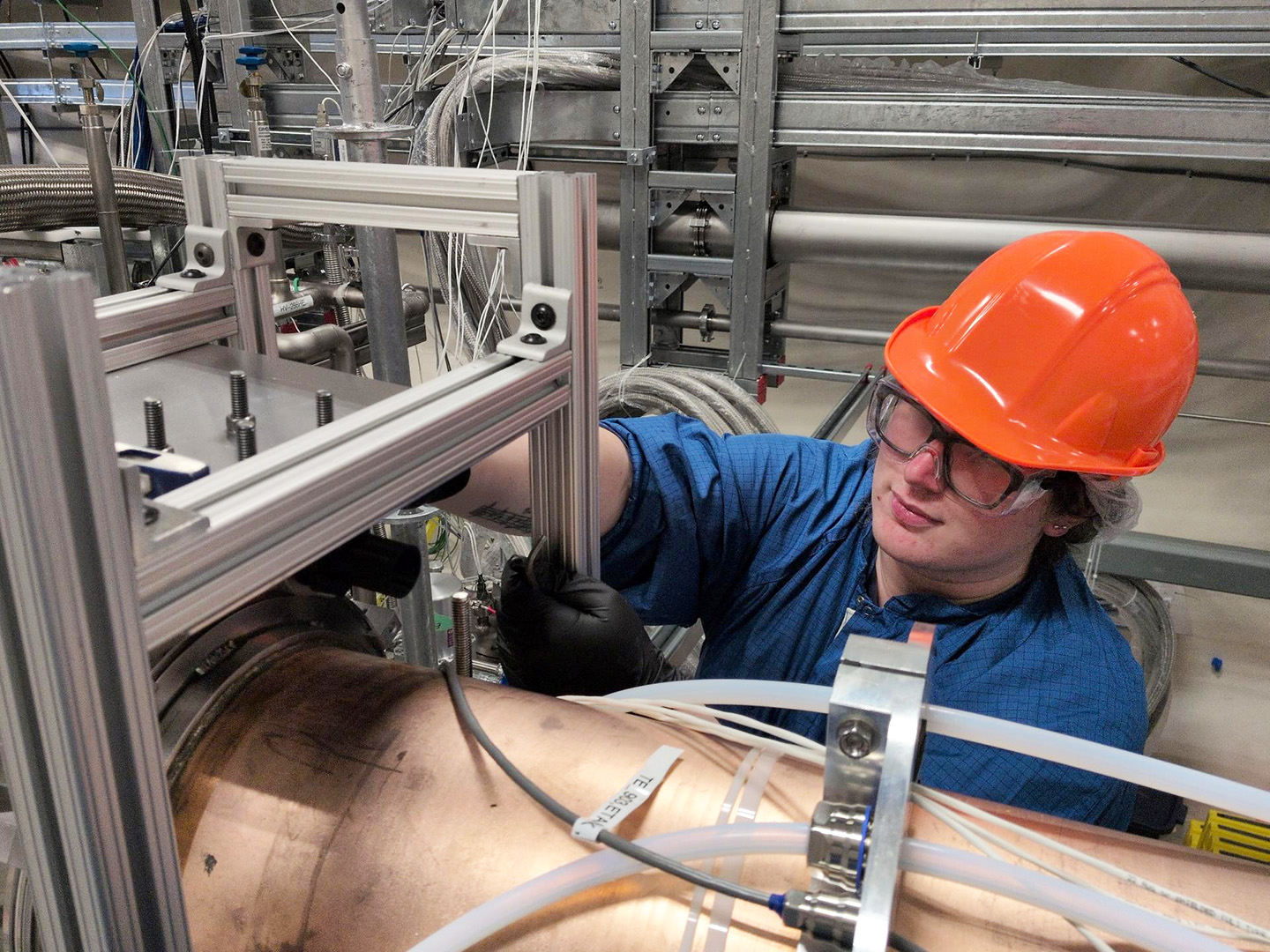
Researchers at South Dakota Mines are playing a key role in the global search for dark matter through their advanced radon detection and reduction system for the Super Cryogenic Dark Matter Search (SuperCDMS) at SNOLAB, a research facility located about 6,800 feet underground in an active nickel mine in Ontario.
Scientists in the collaboration, which includes those from Mines, recently hit a milestone
by cooling the experiment to the temperature required for the superconducting detectors
to become operational, a temperature that is about a hundred times colder than outer
space. This temperature creates the ultra-quiet conditions needed to detect some of
the faintest signals in the universe.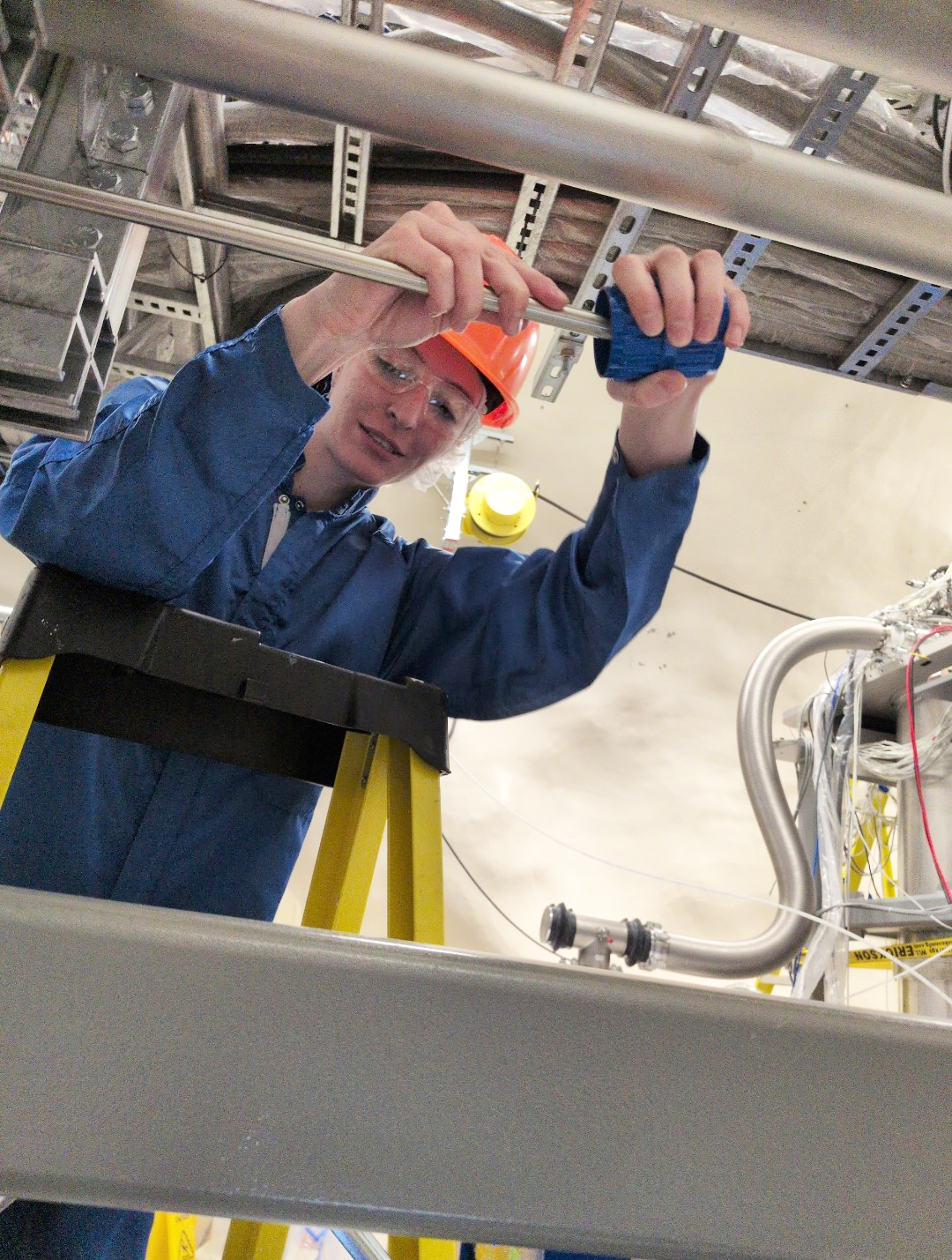
Nevena Cail, a physics graduate student at Mines, contributed to the cooldown by taking a week-long graveyard shift, making sure that the cooldown was continuing as expected.
“The cooldown to subatomic stillness demands patient vigilance,” Cail said.
The undertaking takes collaboration that is maintained through rotating cryo-monitoring, tracking system fluctuations and alerting specialists to prevent risk to the state-of-the-art apparatus, she added.
“One small drop in temperature for an Earthly experiment; one giant cold plunge into the universe's depths of elusive mystery,” Cail said.
In development since 2018, SuperCDMS will soon begin its first science run, zeroing in on light dark matter.
At the center of the university’s contributions is Richard Schnee, Ph.D., head of the Mines physics department, whose team specializes in mitigating one of the most persistent challenges in ultra-sensitive underground experiments – radon.
Schnee has been with the experiment since its beginning.
“Even trace amounts of radon can overwhelm the signals we’re trying to detect,” he said. “If not carefully controlled, radon backgrounds can mimic or obscure the rare events that could point to dark matter. Our goal is to eliminate as much noise as possible to ensure the detector produces the highest-quality data.”
Like the underground lab at Sanford Underground Research Facility in Lead, S.D., SuperCDMS’s deep underground location shields the experiment from cosmic radiation. Still naturally occurring radon and its radioactive decay products can interfere with results. Schnee and his team have designed systems to detect and remove radon, ensuring ultra-clean conditions.
Their work builds on the previous success of the LUX-Zeplin dark matter experiment (LZ) where Schnee’s group helped create a system that reduced radon by more than 1,000 times. Group members Sagar Sharma Poudel, Ph.D., Mines postdoctoral research scientist, Cail, and Ryott Glayzer, sophomore physics major, are currently working on the installation of the radon purge system for SuperCDMS.
“This system is going to reduce the radon backgrounds by a factor of 100, making our experiment over eight times more sensitive to dark matter searches,” Poudel said.
SuperCDMS is an international collaboration led by SLAC National Accelerator Laboratory, with Mines among the 26 participating institutions. The experiment uses ultra-pure silicon and germanium crystals to detect tiny vibrations and electrical signals that could detect dark matter particles
With commissioning underway, researchers expect to begin collecting data soon, bringing them closer to potentially detecting one of the universe’s most elusive components.
For more details, see the news release from the SLAC National Accelerator Laboratory.