

South Dakota Mines Professor Receives ACCESS Award to Study Reliability of AI Speech Recognition
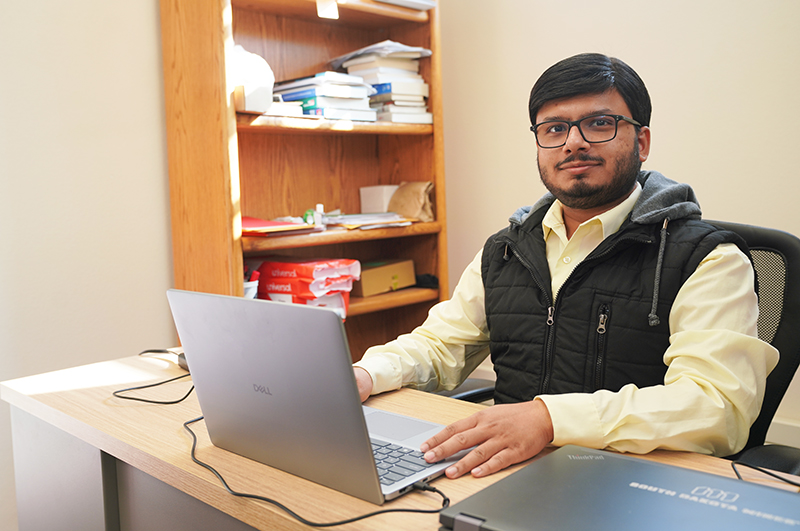
Nirmalya Thakur, Ph.D., assistant professor in the Department of Electrical Engineering and Computer Science at South Dakota Mines, has received 200,000 ACCESS Credits through a National Science Foundation-funded program to advance research aimed at making artificial intelligence-powered speech recognition more accurate and reliable. The research could help improve automatically generated captions and transcripts, making spoken information more accessible to people who are deaf or hard of hearing and others who rely on this technology.
Thakur’s project, Evaluating How GPU Systems Affect the Accuracy, Reproducibility, and Efficiency of Publicly Available Automatic Speech Recognition Models, was selected for support through the Explore allocation category of ACCESS, which provides researchers with access to advanced computing systems and services.
The allocation will give Thakur access to computing resources needed to conduct larger, more systematic evaluations of publicly available automatic speech recognition models. The credits will support repeated experiments across different computing systems to compare the accuracy, reproducibility and computational efficiency of speech recognition models.
“I am grateful that this project has been selected for support through the U.S. National Science Foundation (NSF)–funded ACCESS program,” Thakur said. “The award will provide advanced computing resources for larger, more systematic studies of the accuracy, reproducibility, and computational efficiency of speech recognition systems. Advances in AI have expanded the capabilities of speech recognition technologies used to access spoken information and interact with digital systems in fields such as education, healthcare, business and entertainment. This award will expand my research in artificial intelligence and high-performance computing, with a focus on advancing speech recognition and strengthening the scientific foundations of dependable AI systems.”
Through this research, Thakur will investigate how different graphics processing unit computing systems influence speech recognition models’ outputs and computational performance. The work will compare how accurately and consistently the same speech recognition models convert speech into text across computing environments, as well as the computing resources required to run the models.
The findings could have important implications for people who depend on automatically generated captions and transcripts, including individuals who are deaf or hard of hearing. Errors in automatically generated transcripts can change the meaning of a speaker’s message, potentially creating barriers to information and communication. By identifying factors that affect recognition accuracy and consistency, the research aims to help strengthen the scientific foundation for more dependable speech recognition technologies.
ACCESS, or Advanced Cyberinfrastructure Coordination Ecosystem: Services & Support, connects researchers and educators with the nation’s advanced computing systems, specialized resources and services. Funded by the NSF, the program supports computationally intensive research that may exceed the capabilities of a researcher’s desktop computer or local computing facilities.
Since its launch in September 2022, ACCESS has served more than 2,000 research institutions and supported research across 82 scientific fields, according to program statistics. The program helps researchers pursue investigations requiring substantial computing capacity, including artificial intelligence, large-scale data analysis and complex scientific simulations.