

Mines Faculty Collaborate on Innovative Approach to Extract Rare Earth Elements from Coal Waste
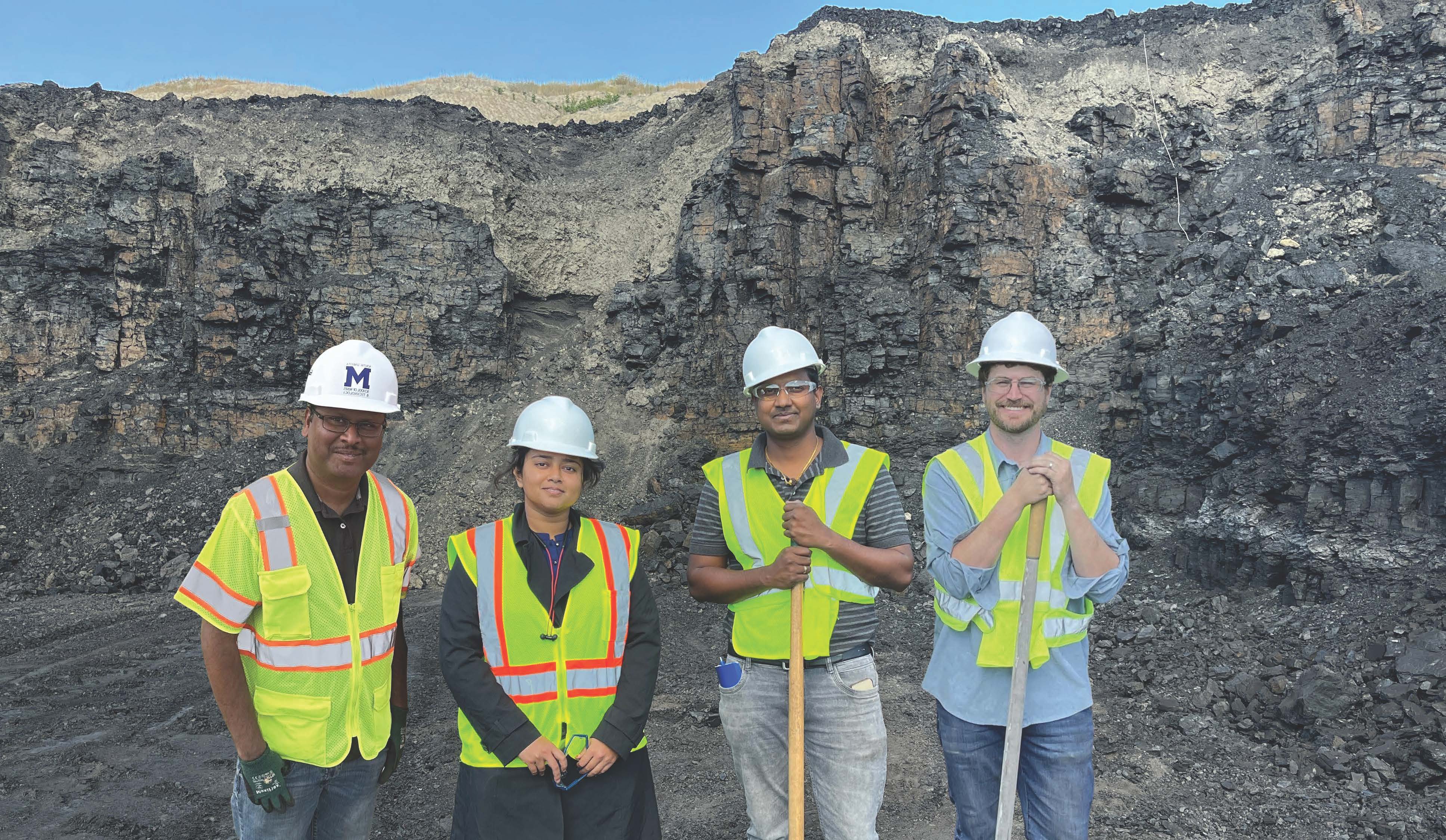
Two South Dakota Mines professors are transforming coal mine waste into a potential domestic source of rare earth elements, materials critical to advanced technology, low-carbon energy and national defense.
After three years of research, Venkataramana Gadhamshetty, Ph.D., professor of civil and environmental engineering, and Purushotham Tukkaraja, Ph.D., professor of mining engineering and management, have developed a sustainable method to extract rare earth elements (REEs) from discarded coal mine waste. The pair will present their research to a group of government and university researchers on Wednesday, Feb. 11.
The project began with a seed grant from a National Science Foundation award, which led to the formation of the current 2DBEST Center and continued support from the Office of Surface Mining Reclamation and Enforcement (OSMRE) and the U.S. Department of the Interior.
“The goal of this study was to develop the technology and understand the process,” Tukkaraja said.
Working with Wyoming coal mines, Gadhamshetty and Tukkaraja used the commonly discarded top rock layers and coal ash to extract small quantities of rare-earth elements, including yttrium, dysprosium, erbium, ytterbium and gadolinium.
“These rare earth elements are essential for technologies such as electric vehicles, wind turbines, smartphones, LED lighting, fiber-optic internet, medical imaging and national defense systems,” Gadhamshetty said. “Among those elements, dysprosium, ytterbium and erbium are considered high-value REEs because they are in strong demand and difficult to replace, while yttrium and gadolinium are widely used, high-volume REEs in electronics, lighting and healthcare.”
By combining expertise from environmental and mining engineering, the researchers developed a novel, three-stage treatment process that integrates physical, chemical and biological techniques.
The process begins with breaking down large rock fragments to increase access to the embedded elements. Environmentally friendly chemicals are then used to convert the REEs from solid to liquid form, enabling selective extraction of the elements. In the final stage, microorganisms absorb dissolved elements, effectively concentrating them inside living cells.
“Once the transfer is being done, you are able to capture all those precious materials into the microbial cells – using living beings to consolidate the dilute levels of these rare earth elements from larger bodies,” Gadhamshetty said.
He compared the biological step to human nutrition. Just as people need vitamins, microorganisms require some of these elements in trace quantities. “We understand those needs and can optimize conditions, so the microbes naturally take up the rare earth elements, creating a mutually beneficial relationship,” Gadhamshetty said.
Aside from the pair’s three-step treatment process, Gadhamshetty and Tukkaraja have also been working to treat water from coal mines, using the same principles to extract rare earth elements from the wastewater.
The next stage is to scale up the process, address associated challenges and make it more commercially viable.
“Once we start incorporating all these different metrics and make it more feasible, we might find stakeholders who would see the value in this solution,” Tukkaraja said.
Building on the extensive body of work in traditional mineral extraction, this research explores the added value of integrating chemical and biological separation methods.
It also explores the benefits of collaboration across multiple disciplines.
“This work shows how interdisciplinary collaboration can turn an environmental challenge into an economic and strategic opportunity,” Tukkaraja said.
Gadhamshetty and Tukkaraja said the research was a team effort with contributions from many collaborators across various disciplines, including Qublisamy Parthiba, Ph.D., former research scientist in the civil and environmental engineering department and principal investigator of the rare earth elements grant; Brett Carlson, Ph.D., Mines assistant professor of metallurgical engineering; Jayaraman Sridharan, Ph.D., research scientist of mining engineering; Tippabattini Jayaramudu, Ph.D., research scientist of civil and environmental engineering; and Mahzuzah Zahan (MS CE 25).