

From Cornfields to Carbon: Mines Researchers Transform Corn Stover into Carbon for Batteries and Supercapacitors
Imagine if the leftover stalks from South Dakota cornfields could power the next generation of electric vehicles, AI data centers and even NASA space missions.
Researchers at South Dakota Mines are proving that they can.
Through a U.S. Department of Energy grant awarded in 2019, Rajesh Shende, Ph.D., interim department head and professor in the Karen M. Swindler Department of Chemical and Biological Engineering, and his team have developed a process to convert corn stover, the stalks and residue left after harvest, into high-quality, battery-grade carbon materials. The carbon, held in large mason jars at the off-campus warehouse, is being used to dramatically improve the performance of lithium-sulfur batteries and supercapacitors, technologies widely regarded as the future of energy storage.
Despite a two-year delay due to COVID, the team achieved its first successful batch on Christmas Eve 2025 and is now ready for its next step – commercialization.
Shende and his team competed in the South Dakota Governor's Giant Vision Open Competition and won third prize with $5,000 in prize money.
“This started as a lab-scale idea,” Shende said. “Our goal was to find value in what is currently waste and turn it into products that can generate revenue, reduce fuel costs and benefit farmers.”
The carbon material Shende’s team is producing in its pilot-scale reactor is high-quality
and superior to that from its lab trials. The milled corn stover utilized for the
pilot-scale processing was supplied by Idaho National Laboratory.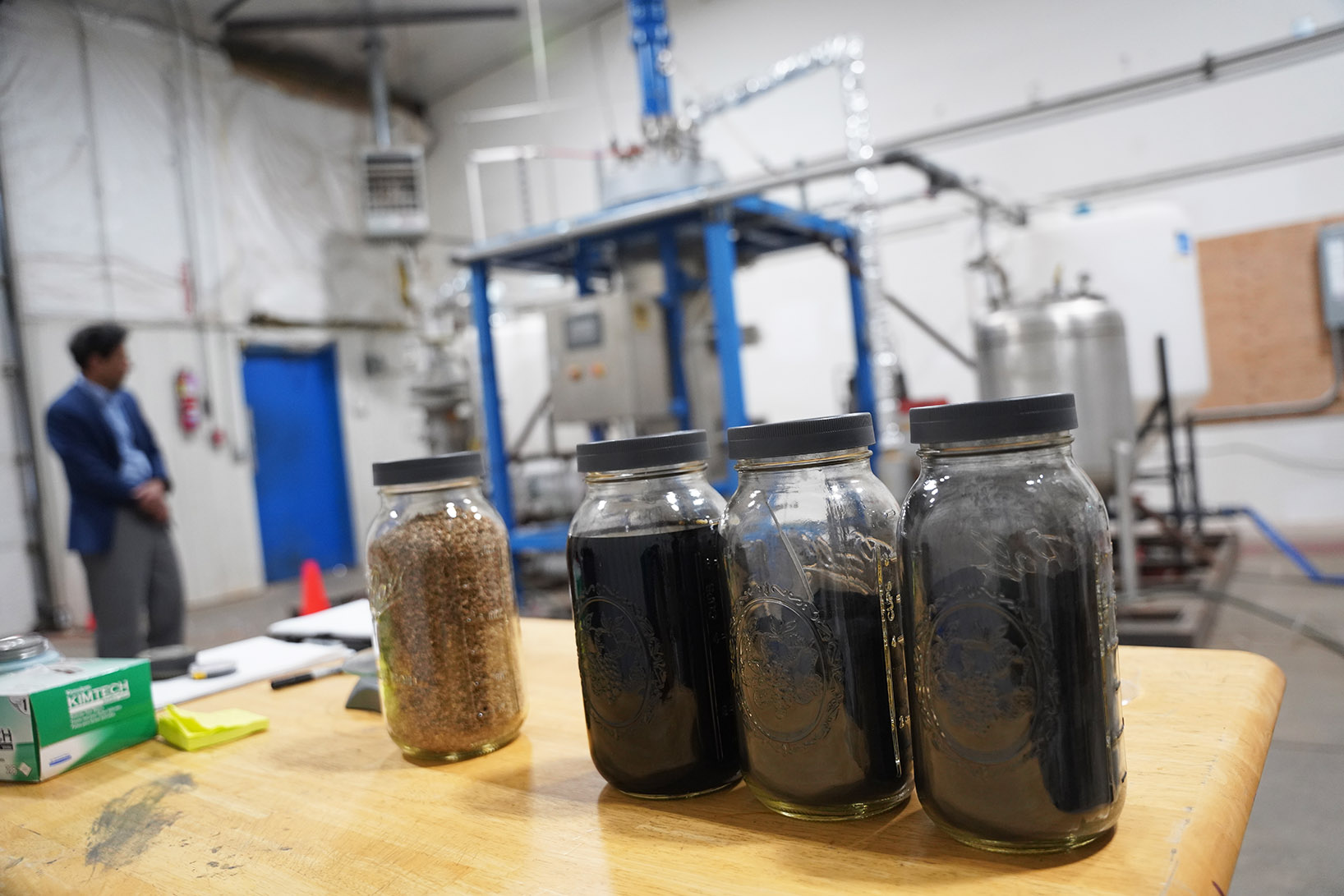
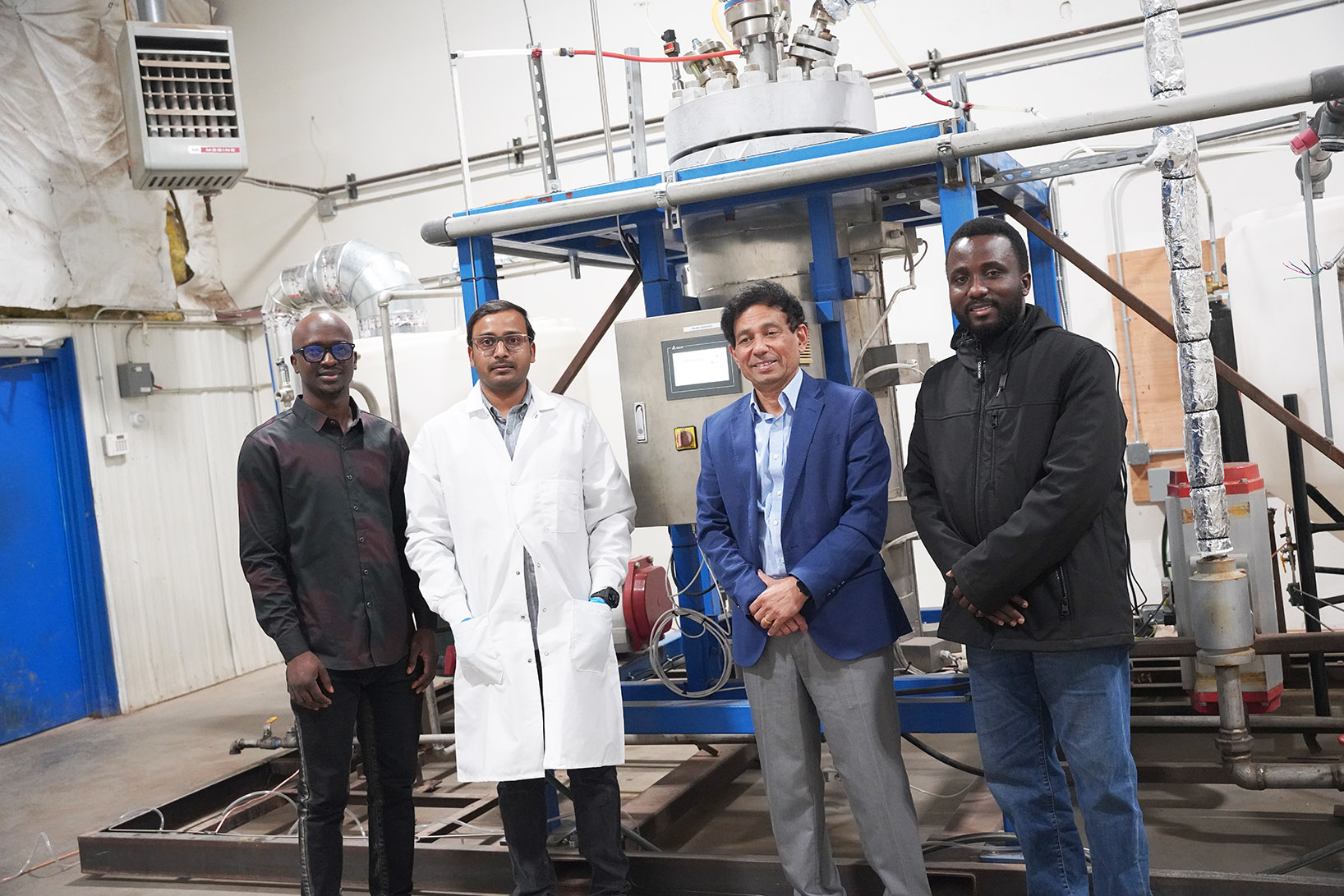
South Dakota produces millions of tons of corn each year. While the grain is processed into biofuels, roughly half of the plant’s mass often remains in the field or is used for grazing and low-value purposes. Shende and his team, including Bharath Maddipudi, Ph.D., Mines postdoctoral researcher, and newly joined students Ibukunoluwa “Paul” Olasesan, doctoral student in chemical and biological engineering, and Afolabi “Abraham” Odesanmi, chemical engineering graduate student, are using hydrothermal liquefaction (HTL) technology, a process of converting wet biomass and waste into high-energy-density biocrude oil, to transform that agricultural waste into carbon. Maddipudi played a key role in installing, commissioning, and testing a pilot-scale reactor system, successfully producing ultra-high-surface-area porous carbon from corn stover.
Aside from the current team working on the project, several Mines students across various disciplines have been involved with the research and production.
“Processing a single one-ton bale of corn stover yields approximately 0.4 tons of carbon,” Shende said. This process transforms low-value agricultural residues into high-value advanced materials, with projected revenues that are much greater than the baseline price of a corn stover bale.
From the raw material, different types of carbon can be produced and used for batteries and supercapacitors, which can then be stacked and used to support grid stability and emerging AI infrastructure, Maddipudi said.
“The good thing about this carbon is that it is sustainable,” Maddipudi said. “It lasts longer than current devices, staying active more than 10,000 charging and discharging cycles, and then the material can be regenerated and reused.”
In addition, Shende said the technology could cut greenhouse gas emissions by up to 70 percent compared to fossil-based carbon materials, often imported, and can be integrated into biorefineries and distributed manufacturing, creating new revenue from agricultural residue.
The project has reached Technology Readiness Level (TRL) 5, meaning it has been validated in a relevant environment on a pilot scale. This type of technology has yet to be commercialized in the region, and the team is now focused on scaling production, identifying commercial partners and defining customer specifications.
Aside from the state’s Giant Vision Competition, Shende and his team are exploring additional commercialization pathways such as the National Science Foundation I-Corps and sending carbon samples to potential customers in the energy storage industry.
And while the current focus is on batteries and supercapacitors, the carbon can be used for products from carpets to water purification systems.
This technology could position South Dakota as a leader in advanced carbon manufacturing, turning agricultural waste into high-demand materials. As the team moves toward commercialization, the project also highlights how research at Mines is driving economic growth and delivering sustainable innovation with global impact.