

South Dakota Mines Student Gains Real-World Wildfire Forecasting Experience Through Summer Internship
As triple-digit temperatures settle across western South Dakota, the threat of wildfires grows with every hot, dry and windy day.
Behind every firefighting operation, meteorologists are tracking constantly changing weather conditions that can determine how quickly a fire spreads and how crews respond. For Gavin Bird, South Dakota Mines atmospheric and environmental sciences student, that critical work has become the focus of his summer internship with South Dakota Wildland Fire, where he is learning how weather forecasting helps protect communities and support firefighters across the Black Hills.
Based in the Weather Lab on campus, he works alongside Darren Clabo, Ph.D., associate professor of practice and state fire meteorologist, gaining firsthand experience in the science behind wildfire prediction and response.
“The weather directly dictates how a wildfire moves across a landscape,” Clabo said. “Fire managers need to know what the weather is going to do so they can better prepare for potential wildfires, and so they can best direct suppression resources if a wildfire has already started. It is imperative for students to understand how fire managers and firefighters operate so that when they become professional meteorologists, they can better serve the community.”
The skillset Bird is developing during his internship is not something learned in the classroom, Clabo added.
Bird has spent much of his summer shadowing Clabo, learning how weather information is used to support firefighting operations. The two recently hiked up behind campus to study the grass and soil conditions. His internship has also taken him to wildfire offices across the Black Hills, where he has met firefighters, observed morning operational briefings and learned how weather forecasts influence decisions made on the fire line.
While Bird’s internship mainly involves fighting fires “behind the scenes”, he is, in fact, training to be a certified wildland firefighter. As part of his training, he completed online instruction and participated in a live-fire exercise in Custer State Park.
“I got to tie in with a couple of hand crews down there, dig some (fire) line and play with live fire,” he said. “That was a lot of fun.”
The experience has given Bird a better understanding of the challenges firefighters face and the weather information they rely on.
“That’s part of what I’ve gotten as well when I’ve toured the different districts,” he said. “I go through their morning briefing, and I see what kind of weather they focus on, so I know what’s most important to them, and how I can best help.”
In addition to operational forecasting, Bird is researching long-term snow-depth trends and how changing winter conditions could affect future wildfire management practices.
“Cold-season prescribed fire is a leading tool we have to manage fuels in the Black Hills,” Clabo said. “There are current policies in place that determine when, and when not, we can apply prescribed fire, and many of these policies are based on snow depth in the Hills. If we have a better idea of how snow depth has changed over time, we can better inform policymakers and decision-makers about what the future may bring. This directly impacts how we manage the wildfire fuels in the Black Hills. We hope that a better understanding of the science will lead to informed policy and improved management decisions.”
Historical data show declining snow depth across the region, a trend that can shorten opportunities for prescribed burning and slash pile reduction during the winter months. Bird’s research explores whether weather conditions such as rainfall and saturated ground could safely provide additional opportunities for burning when snow cover is limited.
“In the last 50-plus years, with our changing climate, it’s definitely been declining in how much snow we get, which is crucial for firefighting operations,” he said.
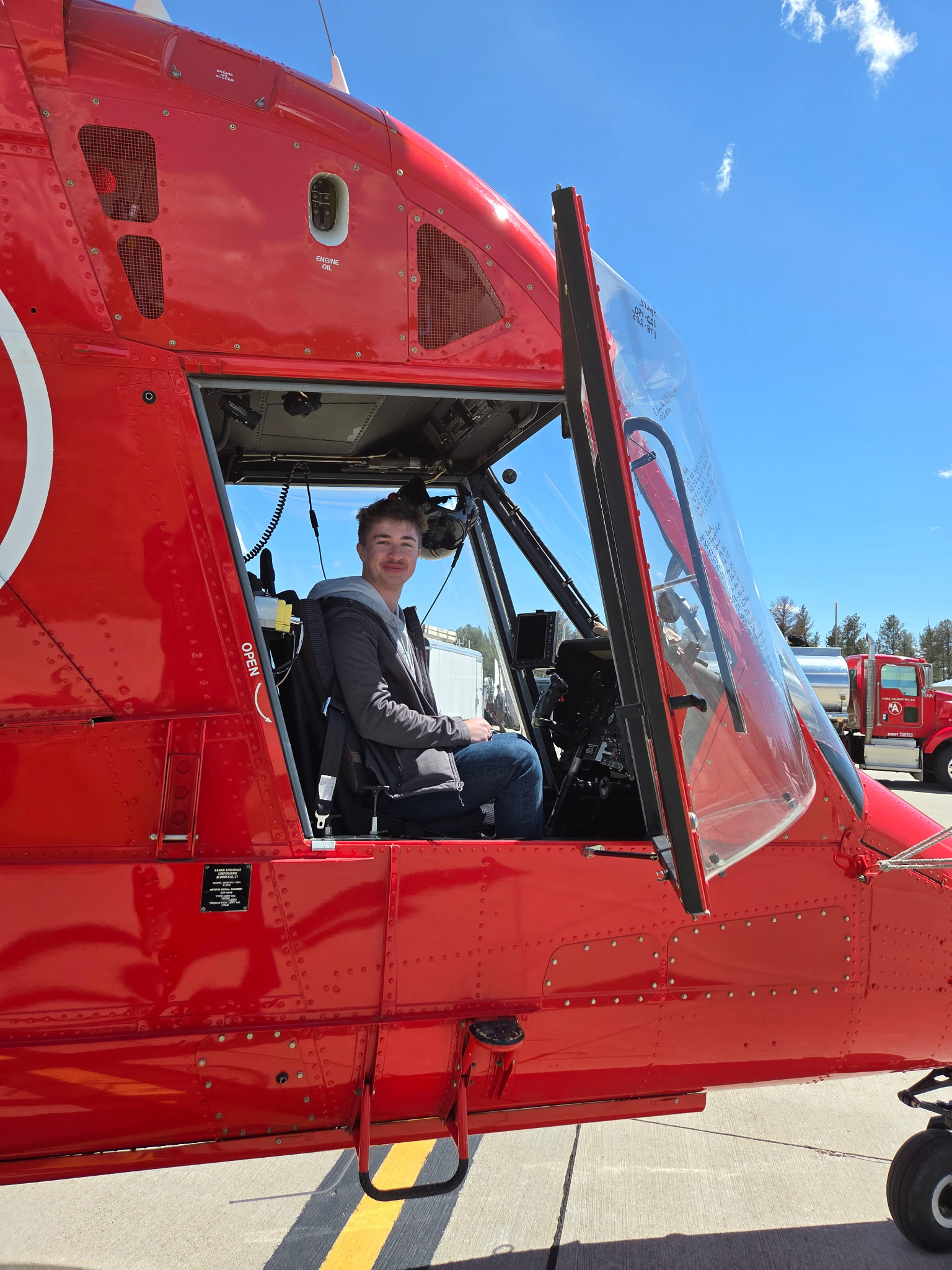
The internship has also provided Bird with an opportunity to combine three longtime interests – weather, wildfire and aviation.
One of the highlights came in June when he visited the Rapid City Airtanker Base as crews supported suppression efforts on the South Fork Fire in northern Nebraska.
“We were cranking through the retardant out of our airtanker base,” he said. “Getting to hang out there was awesome. That was my highlight.”
After graduation, Bird hopes to pursue a career in aviation meteorology, where he can continue applying weather science in operational settings.
“Whether that’s working for the National Weather Service or for a private airline or something, that would be great,” he said. “In a broader sense, I just want to do anything in operations, making forecasts, working with partners, anything like that.”