

A Change in Culture: Mines Greek Life and Lost&Found Aim to Take Pilot Mentorship Program Nationwide
It started as an idea in the back of Whitney Bischoff’s mind – how to harness the built-in brotherhoods and sisterhoods of Greek life to create a movement that reshapes how students support one another on campus.
As student programs manager for Lost&Found, a statewide nonprofit focused on preventing suicide among young adults, Bischoff saw an opportunity.
The organization already runs a Peer2Peer mentorship program, but she knew its impact could grow by tapping into the mentorship already available within fraternities and sororities.
“I had been trying because we know Greek life organizations have informal mentors, little brothers and little sisters, built into their system, but they don’t have a lot of training on what it means to mentor and support the students,” Bischoff said.
The idea gained momentum with Jack Myers, a junior mechanical engineering major at Mines and vice president of Phi Kappa Tau.
“As I was talking on campus this fall, I was speaking with Phi Kappa leadership, and they mentioned it would be a great opportunity in their spaces,” Bischoff said.
From there, interest spread quickly.
“I loved how Lost&Found provides structure to the mental wellness of our house,” Myers said. “It forces these impactful conversations and brings us closer together in brotherhood.”
Bischoff connected with other Mines fraternities and sororities, and the response was positive.
A pilot program funded by the South Dakota Department of Health through next May was launched this spring. Bischoff has already trained four fraternities and a sorority, with momentum building beyond campus.
“We have four Greek organizations at the University of South Dakota who are joining in the program, and a colleague on a national chapter for a different fraternity said they have interest on a national level,” she said.
The goal is to change the culture around Greek organizations.
Bischoff launched the program after reviewing research from the JED Foundation, a nonprofit that protects emotional health and prevents suicide for teens and young adults in the United States. “They have a whole report specifically on Greek organizations,” Bischoff said. “There were some things the organizations were already doing but also had some key recommendations as well.”
The foundation recommends Greek organizations prioritize mental health by reducing stigma, encouraging students to seek help and addressing risks related to hazing, substance misuse and sexual exploitation.
Greek life is built on connection and belonging, something Bischoff saw as a natural fit for a peer support model.
“Peer2Peer offers a ready-made approach that aligns with those recommendations while helping students build resilience,” she said.
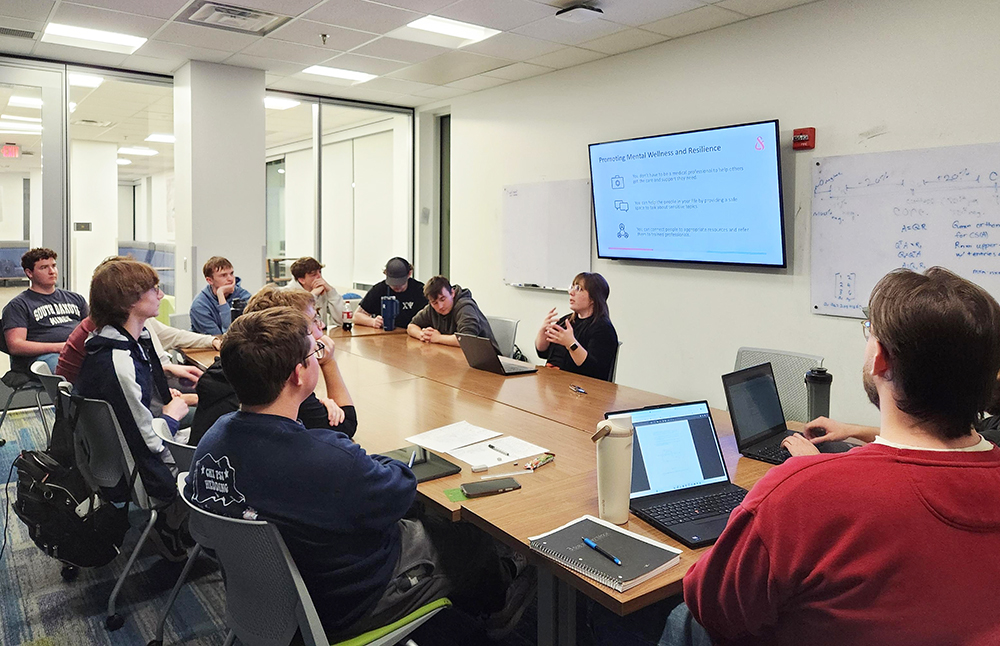
Through the pilot program, participating chapters complete training with Bischoff, covering boundaries, self-care, the mental health continuum, what it means to be healthy and how to access support resources.
The university’s Kappa Tau house started the program this spring and is already seeing positive results. “These topics help guide the conversation in a positive way and create a safe environment for both the mentee and mentor,” Myers said. “I’m excited to see how this pilot program can affect those within our community, further campus collaborations, improved brotherhood morale and stronger personal bonds are all great representations of how our organization can benefit from Lost&Found.”
The students meet weekly or bi-weekly over the course of 16 weeks, using guided prompts while also allowing conversation to develop organically.
“We give them topics to talk about, but also want things to come up organically,” Bischoff said. “I don’t want to know everything they are talking about; I want them to build a relationship and feel comfortable.”
She also wants students to know that there are layers of support. “We want them to have their mentor, but also understand that it is not their only person. We want to create this network of support across campus.”
Bischoff and Myers both see this as having a ripple effect, creating a safe space for future students not only at Mines but eventually across all campuses and beyond their college years.